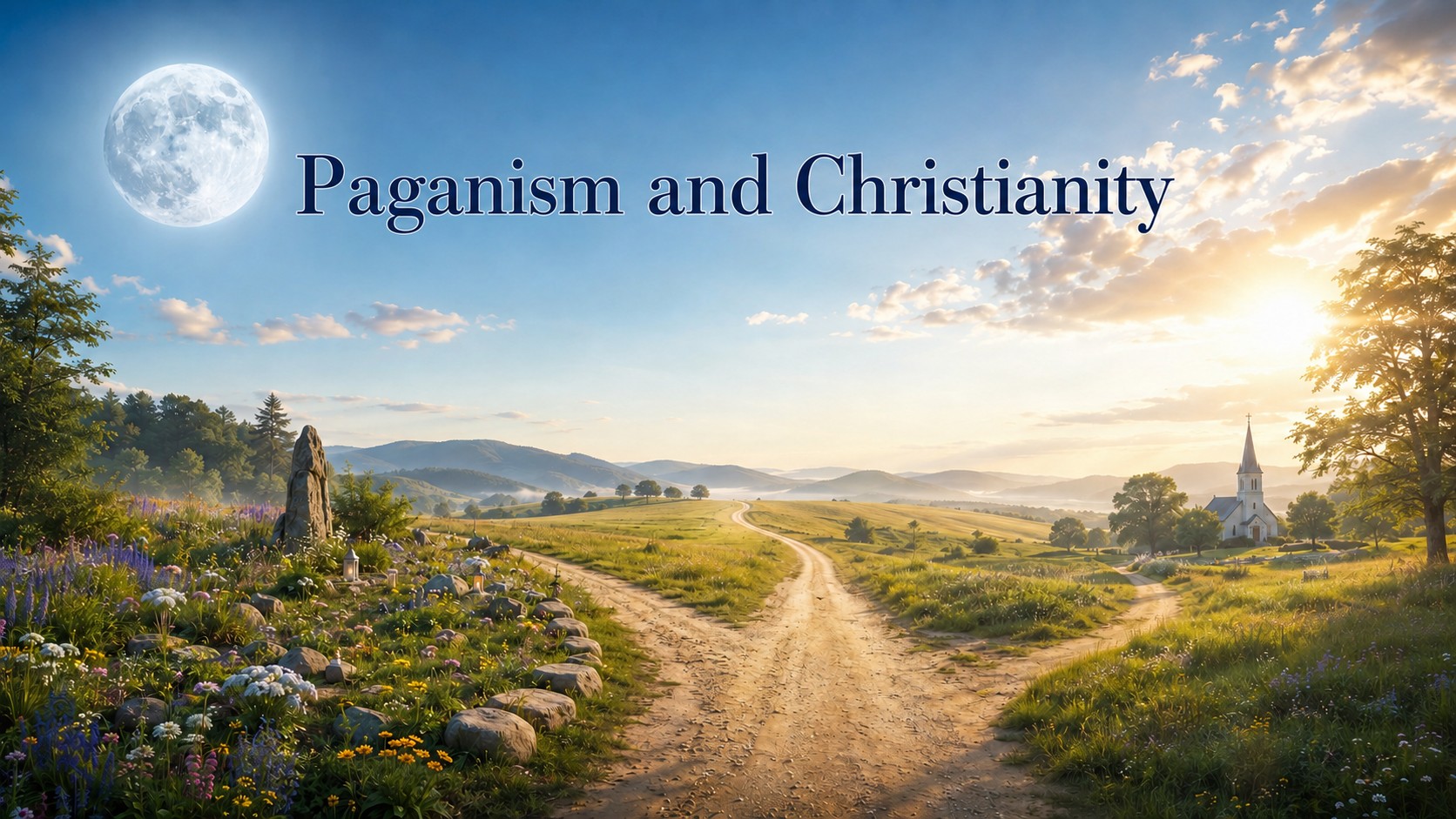
Why unfamiliar beliefs should be understood rather than feared
Paganism is becoming more popular again in many parts of the world. More people are exploring nature-based spirituality, seasonal celebrations, folklore, herbal knowledge and the customs passed down through their families.
In this article, I’ll share my personal observations regarding Paganism and Christianity, explain some of their main differences, explore what they may have in common and discuss why so many misunderstandings still exist.
For some people, Paganism is a religion or spiritual path. For others, it is simply a way of reconnecting with nature, their ancestors or traditions that have been part of their family for generations.
Many people do not consider themselves Pagan but still follow customs with older roots. Lighting candles, celebrating the seasons, honouring ancestors, using herbs or gathering greenery at Christmas may feel like ordinary family traditions. Often, we continue them because they bring comfort and remind us of home and the people who came before us.
Written by Anne-Marie McCormack
Award-winning author, psychic medium, Spiritualist reverend, Reiki Master Teacher and shamanic practitioner with more than 40 years’ experience exploring spirituality, Paganism, Christianity and different world traditions.
This article is based on my personal experience throughout the years, spiritual studies, and time spent living in Cassadaga, Florida, a historic Spiritualist community. I have explored Christianity, Spiritualism, Paganism, witchcraft, Hinduism, Buddhism, Toltec wisdom, Andean spirituality and Ifá. My aim is to encourage understanding and respect rather than promote one spiritual path above another.
What Does Paganism Mean?
Paganism is not one single religion. It is a broad term covering many different spiritual paths, including Wicca, Druidry, Heathenry, witchcraft and other nature-based traditions.
Some Pagans honour several gods and goddesses. Others connect mainly with nature, the changing seasons, ancestors, the Moon or personal spirituality. Some do not worship a deity at all.
This is important because there is no single way to be Pagan. Two people may both describe themselves as Pagan while having very different beliefs and practices.
For many Pagans, nature is sacred. The arrival of spring, the warmth of summer, the changing colours of autumn and the quietness of winter may all carry spiritual meaning.
Pagan traditions often encourage people to become more aware of the natural world and their place within it. This may involve spending time outdoors, marking seasonal festivals, working with herbs, honouring ancestors or creating personal rituals.
How Is Paganism Different from Christianity?
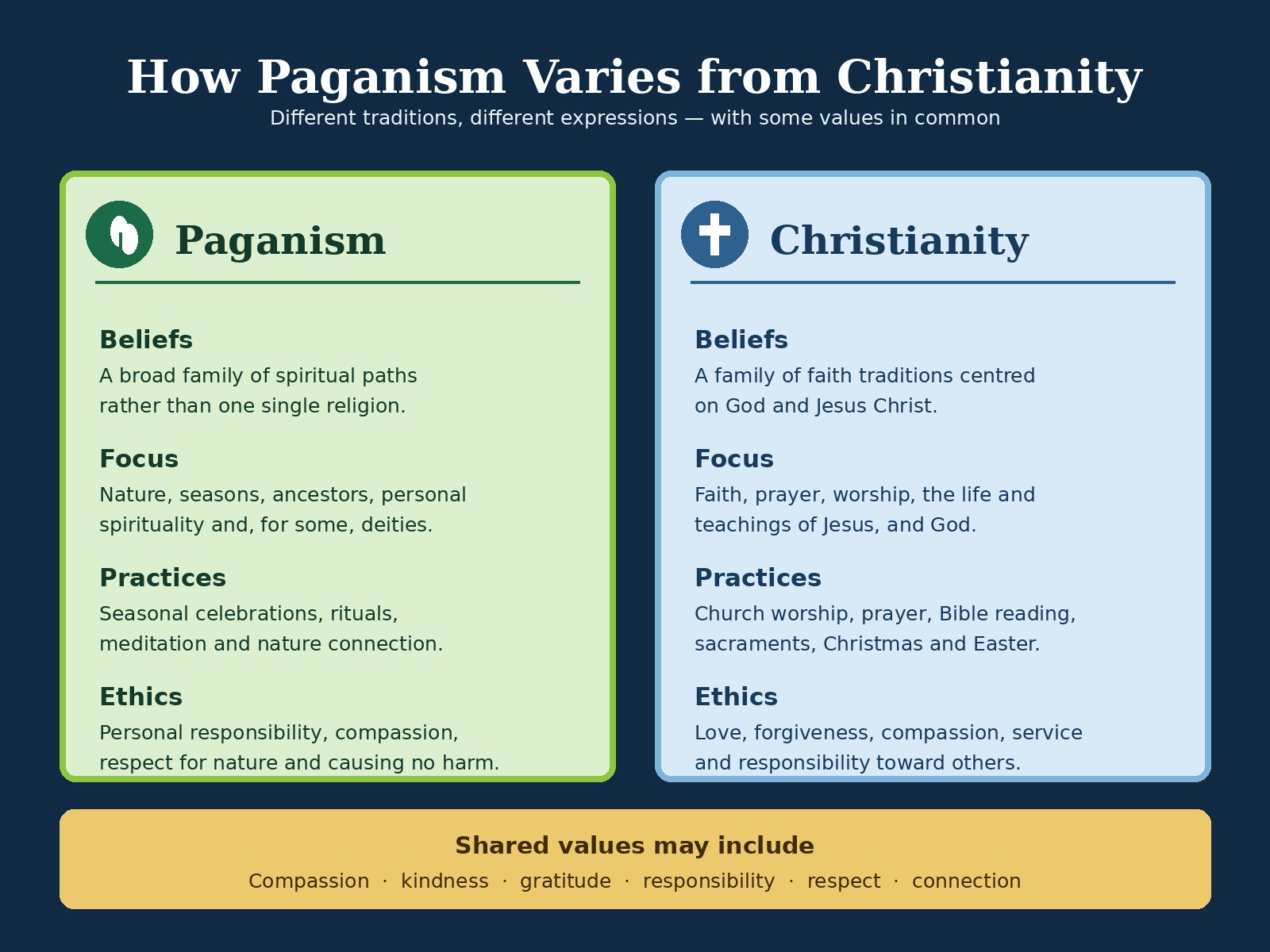
Christianity and Paganism also have different histories, practices and understandings of the divine. They should not be treated as though they are the same.
However, religious traditions often develop within particular cultures and time periods. Some Christian celebrations take place close to important seasonal points, such as Christmas near the winter solstice and Easter during spring. Over time, customs can change, overlap and take on new meanings.
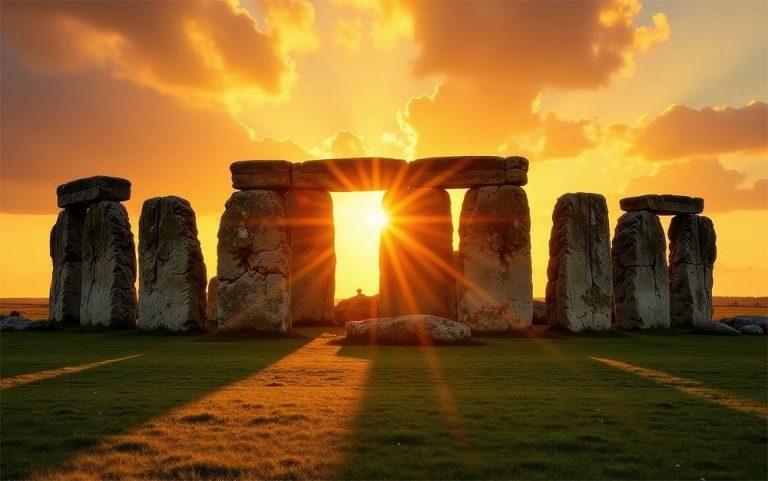
Celebrations such as the winter solstice, spring equinox, May Day and harvest festivals honour light, growth, fertility, gratitude and the changing rhythms of nature. Many Pagans also honour nature-based spirituality and ancient traditions connected with places such as Stonehenge.
Key takeaways Paganism vs Christanity
- Paganism is an umbrella term covering Wicca, Druidry, Heathenry and other nature-based paths.
- Christianity centers on one God and the teachings of Jesus.
- Both traditions can share values like compassion, gratitude and respect for others.
- Pagans are not devil worshippers — Satanism is a separate belief system.
Pagan Customs within Family Life
Some customs practised by families today may have older pre-Christian or folk-tradition roots.
Leaving flowers beside a photograph, lighting a candle for someone who has died, celebrating the harvest, keeping lucky objects or saying a blessing before a journey can all carry spiritual meaning. Yet many people simply think of these things as family habits.
Over the years, the original meaning of a custom may change. A grandmother may teach her grandchild to light a candle or place flowers in a particular room without describing the practice as Pagan.
The tradition continues because it brings comfort, connection and familiarity.
In my own life, I often buy flowers when I am going through a difficult time. I see them as a tribute to the loved ones I have lost and as a reminder that love continues after someone has passed away.
I also light a candle and quietly ask for help, guidance and strength. Someone else may see this as a comforting habit. For me, it creates a moment of stillness and helps me feel connected to my loved ones, Spirit and my own inner strength.
I would not necessarily describe this as following a formal Pagan ritual. It is simply one of the personal ways I express remembrance, hope and faith.
Pagans Are Good People
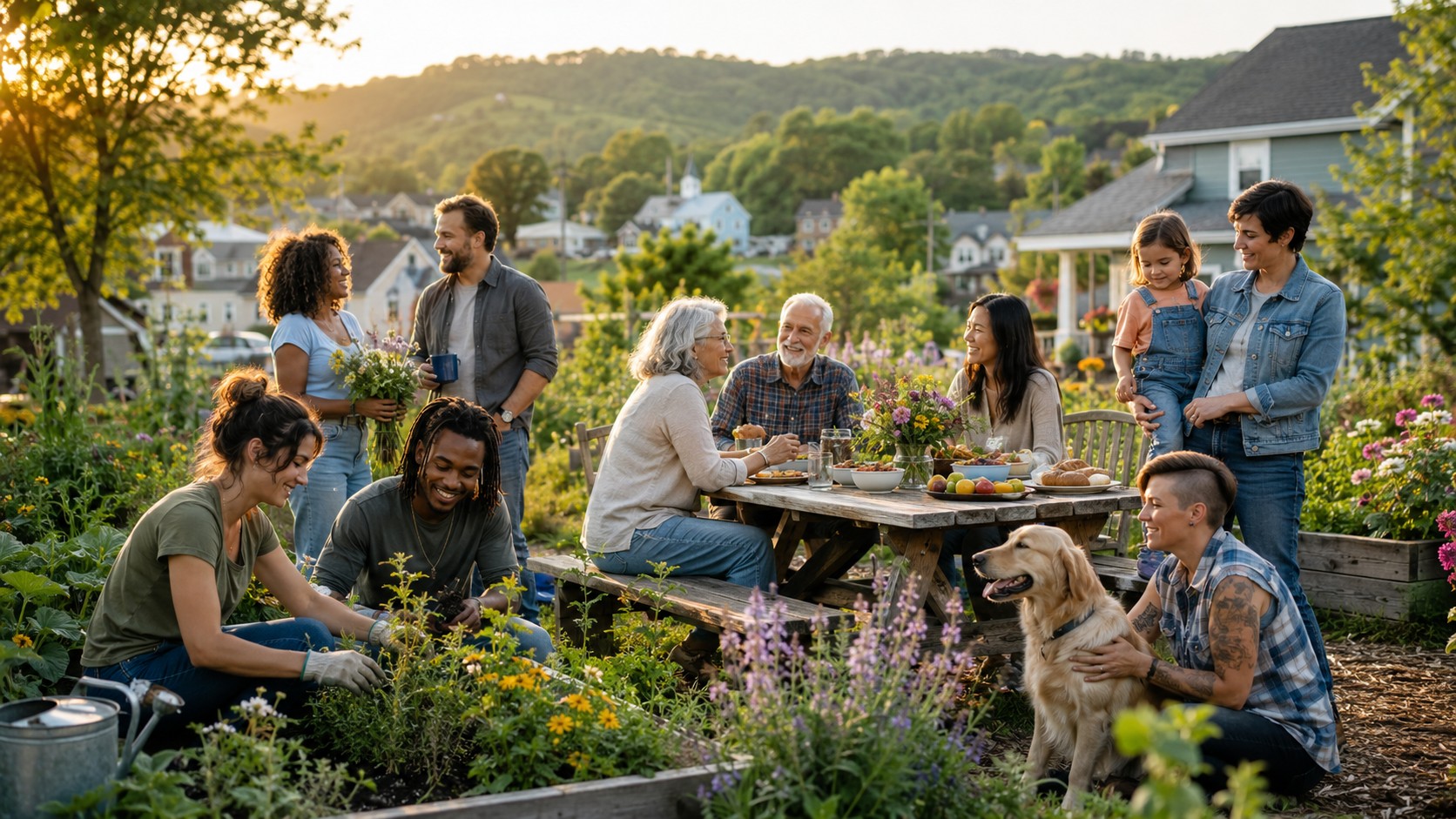
Pagans are ordinary people from all walks of life. They have families, jobs, responsibilities, worries, hopes and dreams, just like everyone else.
Their spiritual beliefs may differ from Christianity, but that does not make them immoral, dangerous or less caring.
Many Pagan traditions place importance on personal responsibility, respect for nature, honesty and compassion. Some Pagans follow the principle of trying to avoid harm and taking responsibility for the consequences of their actions.
Of course, people should be judged by their behaviour rather than by the label they use. There are kind and unkind people within every religion, spiritual path and belief system.
No group has a monopoly on goodness, and no spiritual label automatically makes someone a good or bad person.
It is unfair to assume that someone is dangerous simply because their beliefs are unfamiliar.
Why Are People Returning to Pagan Traditions?
Modern life can leave people feeling disconnected from nature and from one another. Many spend their days surrounded by technology, traffic, noise and pressure.
Pagan traditions can offer a way to slow down and pay attention to the seasons, the Moon, the weather, the land and the natural world.
Some people are also interested in their family history. They want to understand how their grandparents and great-grandparents lived, what they believed and which customs were important to them.
For others, Paganism offers a spiritual path that feels personal and connected to everyday life. It may allow them to explore their beliefs without having to accept one fixed set of teachings.
This does not mean that everyone interested in nature or old customs is Pagan. People may simply be looking for a greater sense of connection, meaning and belonging.
My Own Spiritual Path
My Own Spiritual Path
I was christened within the Christian faith, and I have always respected the teachings of Jesus.
I am also a Spiritualist reverend, psychic medium, Reiki Master Teacher and shamanic practitioner. Over the years, I have learned from many different traditions and explored how people understand life, death, Spirit and the world around them.
Today, I do not identify completely with any one traditional path. My spirituality has been shaped by my life experiences, my connection with Spirit, my love of nature, my family traditions and the wisdom I have found in different teachings.
I follow my own spiritual path, guided by my inner compass and intuition. I try to do good wherever I can and live with compassion and respect.
I also follow the Pagan principle of causing no harm. To me, this means respecting other people, caring for the natural world and taking responsibility for my actions.
My path includes Christian influences, Spiritualist beliefs, Pagan customs and personal experience—but ultimately, it is my own.
I believe spirituality should not place people in boxes or insist that one path is right for everyone. We should be free to explore, learn from different traditions and keep what genuinely resonates with us.
For me, the most important question is whether our beliefs help us become kinder, wiser and more compassionate human beings.
Read my related article, “Paganism and Christianity,” on Medium.
The Andean Shamanic Path

Another spiritual path that has influenced me is the Andean shamanic tradition of South America, particularly Peru. It is rooted in respect for Pachamama, or Mother Earth, the Apus, or sacred mountains, nature, ancestors and the connection between all living things.
A central principle is ayni, meaning sacred reciprocity—the understanding that we should give back to life, nature and others rather than simply take. Although traditions vary, Andean spirituality generally focuses on balance, gratitude, healing, harmony and living with greater awareness.
I do not need to adopt every belief to appreciate the wisdom these traditions offer, including compassion, respect for nature, gratitude, balance and doing no harm.
Toltec Wisdom and The Four Agreements
Toltec wisdom comes from the ancient Toltec tradition of central Mexico and is widely known through Don Miguel Ruiz’s book The Four Agreements.
- Be impeccable with your word.
- Do not take anything personally.
- Do not make assumptions.
- Always do your best.
These teachings encourage honesty, personal responsibility, self-awareness and freedom from inherited fears and limiting beliefs. Although Toltec wisdom comes from a different tradition, many of its values—respect, compassion, integrity and avoiding unnecessary harm—are shared by other spiritual paths.
This is why I believe we can learn from different traditions without having to adopt every belief within them. We can keep what feels meaningful and allow it to help us become kinder, wiser and more aware.
Fear Often Comes from a Lack of Understanding
I experienced this misunderstanding myself one day when I went for blood work in Orange City, Florida. The phlebotomist asked me where I lived, and when I told her I lived in Cassadaga, she looked surprised and said, “Oh, that’s the witches’ town. Do you practise black magic?”
I had to smile because this was such a common misconception. I explained that I did not practise black magic and, in all the years I had lived in Cassadaga, I had never known anyone who did.
I told her that Cassadaga is a Spiritualist community with a long and fascinating history. People live there from all different faiths and backgrounds. They have families, homes, jobs, everyday concerns and personal beliefs—just like people everywhere else.
I encouraged her to visit sometime. She could walk around the community, visit the shops, perhaps attend a Sunday service at the temple and experience the atmosphere for herself. Most importantly, she would have the opportunity to meet the people who live there instead of relying on things she had simply been told. Fear based Spirituality is not a good path for anyone.
Many Spiritualists believe in Jesus and follow Christian teachings, although their understanding of spirituality may be a little different from that of traditional churches. Spiritualism is not about black magic or evil. It is a spiritual path followed by people who are trying to understand life, death and the continuation of the spirit. Why not read my article on 25 Ways to Receive Messages from Spirit
I have also known people who identify as witches, including Celtic, eclectic and solitary witches. If you think you may be a witch, take our quiz, What Type of Witch Are You? You can also explore the differences between these paths in our guide, Are You a Witch, a Psychic, or Both?
It is also important not to confuse witchcraft with Satanism. Satanism is a separate belief system with different branches and interpretations.
I may not agree with every belief or practice, but I do not believe it is fair to label an entire group as evil and witchcraft can be used for good and rarely have I come across witches that use it for ill intent. We need to take the time to understand what the people we interact with actually believe. As with any spiritual or philosophical path, we should judge people by their actions and by how they treat others—not by fear, rumor or misunderstanding.
That conversation in Orange City stayed with me because it reminded me how easily fear can grow from a lack of understanding. When something is unfamiliar, people often repeat what they have heard rather than taking the time to learn about it for themselves.
Throughout history, people have labelled those with different beliefs as evil, dangerous or inferior. Yet someone’s spiritual path does not determine whether they are a good person. What matters is how they treat others, how they behave and whether they try to live with compassion, kindness and integrity.
Respecting Both Paganism and Christianity
Paganism and Christianity are different traditions, but they do not need to be enemies. People should be free to follow the spiritual path that feels right for them, provided they treat others with respect.
A Christian may find comfort in prayer, church and the teachings of Jesus. A Pagan may find comfort in nature, ritual, the seasons and ancient wisdom. Another person may combine family customs, personal spirituality and elements from more than one tradition.
Spirituality is deeply personal. As we become more spiritually aware, we learn that what brings one person comfort may not have the same meaning for someone else.
We do not have to agree with another person’s beliefs to treat them with respect. Learning about different traditions does not weaken our own faith or personal convictions. It simply allows us to see other people with greater compassion.
The old ways have not disappeared completely. They can still be found in the flowers we place beside a photograph, the candles we light for those we love, the harvest celebrations we continue to enjoy and the family traditions passed from one generation to the next.
For me, spirituality is not about finding a label or proving that my path is better than someone else’s. It is about listening, learning, growing and trying to live in a way that brings more kindness into the world.
If this article has helped you, you can support our work by making a donation. Every contribution helps us keep the site ad free and enables us to continue to provide and create free spiritual guidance and resources.
Frequently Asked Questions About Paganism vs Christianity
What is Paganism?
Paganism is an umbrella term for many spiritual and religious traditions, including Wicca, Druidry, Heathenry and nature-based spirituality. Some Pagans honour gods and goddesses, while others focus on nature, the seasons, ancestors, energy or personal spirituality.
What is the difference between Paganism and Christianity?
Christianity is centred on belief in one God and the teachings of Jesus Christ. Paganism includes many different beliefs and practices, often involving nature, seasonal cycles, ancestors or multiple deities. However, both traditions can encourage compassion, personal responsibility and respect for others.
Are Pagan traditions connected to family customs?
Yes. Some customs, such as lighting candles, placing flowers beside a photograph, celebrating harvests, honouring ancestors and gathering greenery, may have roots in older Pagan or pre-Christian traditions. Over time, many of these practices became family customs rather than formal religious rituals.
Are Pagans evil or dangerous?
No. Pagans are ordinary people with families, jobs, responsibilities and different personal beliefs. As with any religious or spiritual group, people should be judged by their behaviour and how they treat others—not by the label they use.
Do Pagans worship the Devil?
Pagans do not worship the Devil. Paganism and Satanism are separate belief systems, and many Pagans focus on nature, ancestors, seasonal traditions or different deities. Pagan beliefs should not automatically be associated with evil or devil worship.
Is witchcraft evil and is it the same as devil worship?
No. Witchcraft is practised by people from many different backgrounds, including Celtic, eclectic and solitary witches. For many practitioners, it involves nature, seasonal cycles, healing, folk traditions, symbolism and personal spirituality. It should not automatically be equated with devil worship.
Is Satanism a form of Paganism?
Satanism is a separate religious or philosophical movement rather than a Pagan tradition. It has different branches and interpretations. Some individuals may combine Satanist and Pagan ideas, but the two are not the same.
Can someone be Christian and Pagan?
Some people combine Christian beliefs with Pagan customs or nature-based spirituality, while others see Christianity and Paganism as separate paths. Spirituality is personal, and people may draw meaning from more than one tradition in a way that feels authentic to them.
Why are more people becoming interested in Paganism?
Some people are seeking a deeper connection with nature, the seasons and their ancestors. Others feel disconnected from modern life and are drawn to a more personal spiritual path involving reflection, ritual, gratitude and awareness of the natural world.
Do Paganism and Christianity share any values?
Although they are different traditions, both may encourage values such as compassion, kindness, honesty, personal responsibility and respect for others. People do not have to share the same beliefs to recognise meaningful values in another spiritual path.